Switching systems
The real question isn’t features. It’s your data.
Every administrator who has lived through a bad migration is right to be cautious. A hospital cannot pause admissions while a vendor works out why the balances do not tie — so we carry that risk instead of asking you to.
What switching costs you
Six zeros.
Changing hospital systems is usually a bill, a project and a bad month. We have taken all three off the table.
₹0
setup cost
Installation and commissioning
Zero
downtime
None since Feb 2026
Zero
disruption
Roll back during the parallel run
Zero
IT overhead
No internal project team
Zero
variable costs
Fixed at signing
Zero
net cost
₹2.2 lakh recovered vs ₹40–50k, at 100 beds
- Current HMS
- Nexus runs in parallel
- Data & workflow validation
- Team adoption
- Go live
Your existing system stays intact and authoritative through the parallel run. Nothing is switched off until the numbers agree.
What we commit to
Five things we put in writing.
Each of these exists because a hospital asked for it after being burned by a previous vendor.
- 1
We migrate your data, and we pay for it
Patient records, drug master, charge master and pricing are brought across from your legacy system by us, at our cost — and your hospital keeps running throughout. Admissions, dispensing and billing carry on with no downtime while the transfer happens. Migration is not a line item on your quote.
- 2
Both systems run in parallel
For an agreed period your existing system stays live alongside ours. You reconcile the two on real patients before anyone commits. Nothing is switched off on day one.
- 3
Our team owns your go-live and supports you throughout
Not a ticket queue. The same team is accountable from the first data pull to sign-off, and stays with you afterwards — you deal with people who already know your hospital, not a rotating support desk.
- 4
An on-site technician for onboarding
We put a technician physically in your hospital for the switchover and the days after it, when the real questions arrive at the counter.
- 5
You can walk back
Your legacy system stays intact and authoritative through the parallel run. If the reconciliation does not satisfy you, you stop — data exported in open formats, no penalty.
Implementation
The software is the easy part.
Most HMS projects do not fail on features. They fail in the six weeks around go-live, when staff are busy and nobody has time to learn a new system. That is the part we staff properly.
- 01
Discovery & configuration
We map your workflow, charge master, wards and departments, then configure the system around how your hospital already works — including white-labelling it to your brand.
- 02
Managed data migration — at our cost
We extract, clean and load your existing patient records, drug master and pricing, and reconcile every total with your team before anyone relies on it.
- 03
Parallel run
Both systems operate side by side on real patients for an agreed period. You compare the two daily. Nothing is switched off until the numbers agree.
- 04
Role-based training
Front desk, nursing, doctors, pharmacy, lab and billing are each trained on their own screens — short sessions, on your floor, in your workflow.
- 05
Supervised go-live, on site
Our technician is physically present for the switchover and the days that follow, when the questions actually arrive at the counter.
- 06
Review & optimisation
Once the system settles we return with the first Revenue Integrity findings and work through them with your management team.
Ongoing IT support is included after go-live — named contacts, not a portal. Support hours and response times.
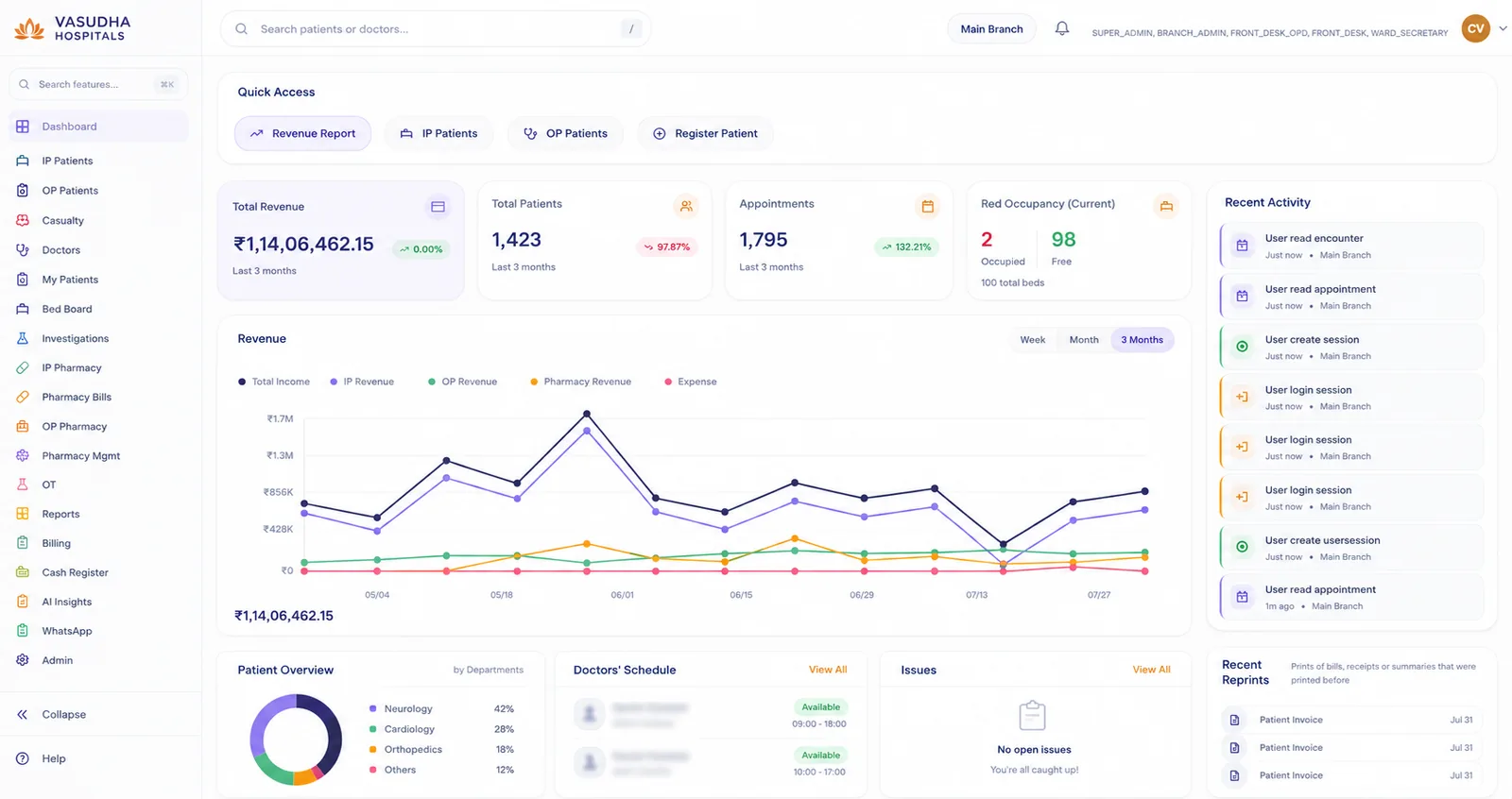
It carries your hospital’s name, not ours.
The screen beside this is the same platform, running as another hospital. Your staff are learning your system, not a vendor’s.
- Your logo and colours across every screen
- Your hospital name on prescriptions and invoices
- Your letterhead on discharge summaries
- Patients never see a third-party brand
Nothing is switched off until the numbers agree.
Book a walkthrough and we will take you through the parallel run, the reconciliation and exactly what happens if you decide to stop.