Revenue Integrity
Revenue leaves in small, boring, invisible ways.
No single missed charge is worth chasing — which is exactly why they accumulate. Every rule below runs in production today, over any date range you choose.
Start here
Prove the value against the HMS you already have.
Revenue Integrity is sold on its own. It reads from your current system and reports what was performed but never billed — without touching a clinical workflow, and without asking your staff to learn anything new.
- No change to your existing HMS
- No clinical workflow disruption
- No staff retraining
- You keep the findings whatever you decide next
If the findings do not justify the cost, you have lost nothing. If they do, you have a number your CFO can act on.
Free revenue leakage assessment
We look at a defined period of your existing billing, pharmacy and order data, and report what is missing from it.
- Cost
- Free
- Turnaround
- 7 days
- Disruption
- None
No obligation to buy anything.
How it runs
Clinical activity happened. Did it reach the bill?
Clinical, billing and inventory data are cross-checked against each other continuously, and each finding is routed to the person who can still fix it.
Hospital activity
- Bed occupied
- Lab completed
- Medicine administered
- Procedure performed
- Consumable used
- Claim settled
Nexus
Revenue Integrity Engine
- Clinical data
- Billing data
- Inventory data
Cross-checked continuously, over any date range
Opportunities detected
- Bed days not billed
- Lab completed but never billed
- Medication administered, missing from invoice
- Short-paid insurance claims
Recoverable revenue
₹2.2 lakh / month
Identified and recovered at a live 100-bed hospital.
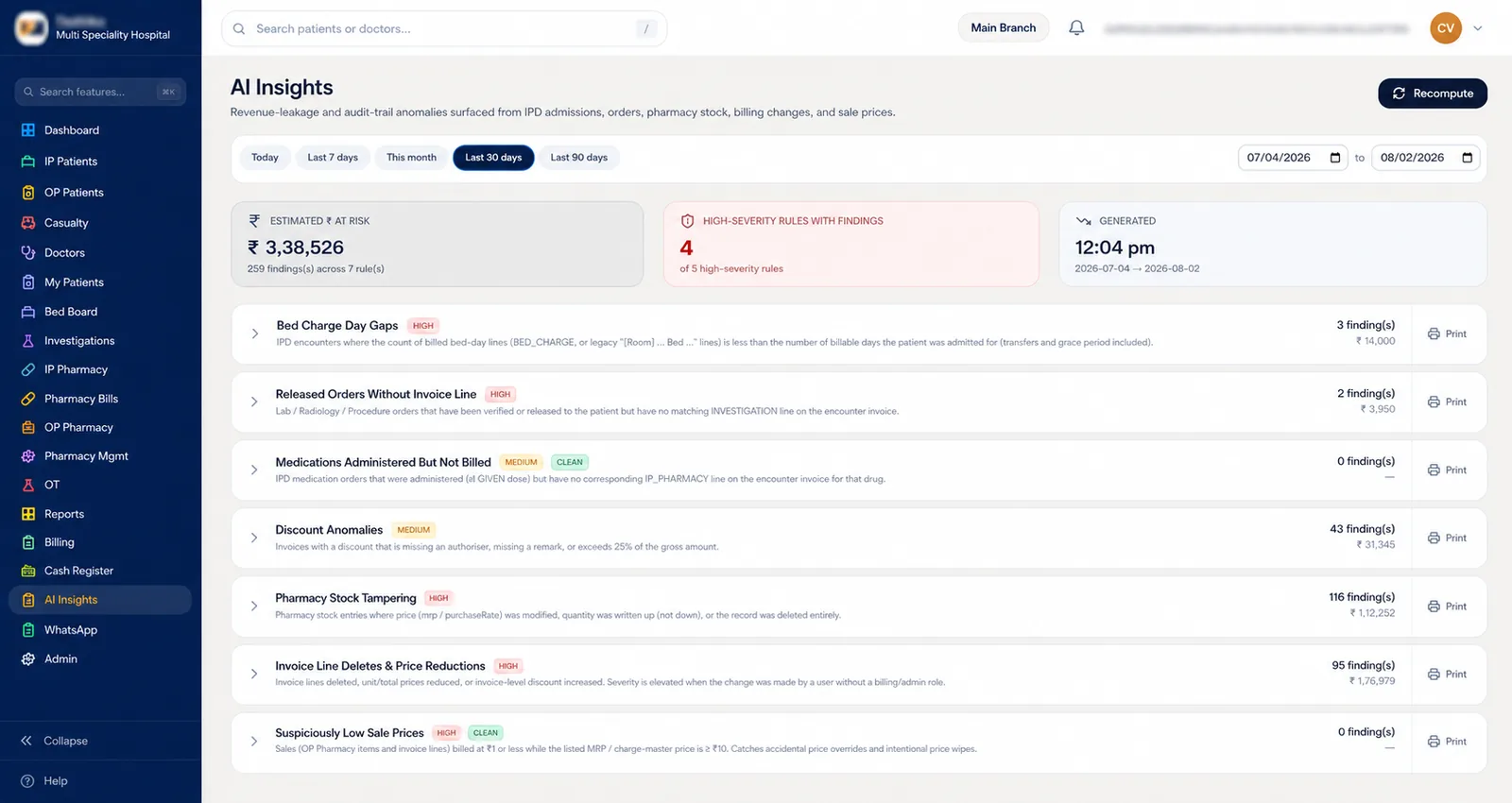
The rule set
Eleven detectors, every one configurable.
Thresholds, severity and what counts as an exception are set against your charge master, your discount policy and your grace periods.
Bed Charge Day GapsHigh
IPD encounters where the billed bed-days come to less than the days the patient was actually admitted for — transfers and grace periods included.
Released Orders Without Invoice LineHigh
Lab, radiology and procedure orders verified or released to the patient with no matching investigation line on the invoice.
Medications Administered But Not BilledMedium
IPD medication orders with at least one dose recorded as given, but no corresponding pharmacy line on the encounter invoice for that drug.
Discount AnomaliesMedium
Invoices carrying a discount with no authoriser, no remark, or above 25% of the gross amount.
Pharmacy Stock TamperingHigh
Stock entries where the price was modified, the quantity was written up rather than down, or the record was deleted outright.
Invoice Line Deletes & Price ReductionsHigh
Lines deleted, prices reduced or invoice-level discount increased — escalated when the change came from a user without a billing or admin role.
Suspiciously Low Sale PricesHigh
Items billed at ₹1 or less against a listed price of ₹10 or more. Catches accidental overrides and deliberate price wipes alike.
OT & procedure charges
Procedures recorded in theatre with no matching charge on the invoice — including the second procedure added mid-list, which is the one that usually goes missing.
Ward & OT consumables
Sutures, implants and disposables issued against a case but never charged. Individually small, and the largest silent loss in most hospitals once totalled.
Claim rejection causes
Documentation and coding gaps that get claims rejected, flagged before submission while the file can still be corrected rather than six weeks later.
Short-paid claims
A settled claim is not a paid claim. Every remittance line is matched against what was billed, so TPA deductions get challenged instead of quietly absorbed.
Tuned to your hospital, not ours.
A 25% discount that needs an approver at one hospital is routine at another. Rules you do not want are switched off, and rules you need that are not here get written.
Care gaps
Find the patients who never came back.
Revenue Integrity finds what you did and did not bill. Care gaps find what should have happened and never did — the post-op review nobody booked, the diabetic who stopped attending, the result nobody acted on.
Chronic care review overdue
Diabetic, cardiac and renal patients carry a review interval. When the date passes without a visit, the patient surfaces on the worklist rather than quietly disappearing.
Post-procedure follow-up never booked
Every procedure can generate a follow-up with a due date. If it is never scheduled or never attended, it is flagged instead of closed.
Lab review nobody acted on
A released result with no follow-up encounter against it is a gap in care and an unbilled visit at the same time.
Vaccination and immunisation due
Scheduled doses track against the due date, so a child or adult falling out of a schedule is visible before the window closes.
Missed appointments
Appointments are marked no-show automatically through the day, and the patient goes into outreach the following morning.
How it runs
- 1
Detect
Runs every day against due dates, no-shows and open follow-ups.
- 2
Prioritise
Gaps carry a type and urgency, so clinical risk outranks routine recall.
- 3
Remind
The reminder goes out from inside the platform — WhatsApp, SMS or email.
- 4
Close
Booking an appointment closes the gap and links it back to the encounter.
Reminders go out over WhatsApp by default — the channel patients actually read, at a fraction of the cost of SMS.
Protocol-driven detection
Gaps are derived from the diagnosis itself, not only from a follow-up someone remembered to raise. Every diabetic overdue for an HbA1c, every patient eligible for a screening they have not had — the system reads the clinical record against the protocol and surfaces the gap without anyone creating a reminder first.
That is the difference between a recall list and a clinical safety net: it catches the patients nobody thought to add.
Whether this pays for itself is yours to check, not ours to assert.
Work out the paybackStart with a number, not a proposal.
We run the assessment against your current system and report what is missing from it. 7 days, free, and you keep the findings either way.